Corsi · CEFR A1 level
German A1
German A1 è un corso online di tedesco da seguire in autonomia, livello CEFR A1, della Goethe Academy: 80 lezioni in 10 unità, un test dopo ogni unità e un test finale. Spiegazioni in inglese, materiale linguistico in tedesco, con audio. Prezzo AED 249 (USD 69), pagamento unico, 12 mesi di accesso. La prima lezione è gratuita. Al termine ricevete un attestato di frequenza della Goethe Academy; non è un esame di lingua ufficiale.
Your first 650 words of German, real everyday conversations and the grammar that holds them together. From “Hallo!” to telling a friend what you did at the weekend.
AED 249 · USD 69
Pagamento unico. 12 mesi di accesso. Nessun abbonamento. Addebito in AED; la vostra banca effettua la conversione. Le altre valute sono indicative (cambi del 2026-11-19).
Iniziate la lezione gratuitaAcquista il corso
Progressi
Unità 1
- Hallo!Greetings, introductions
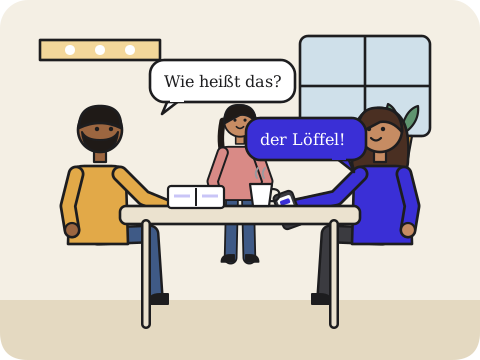
- 1 Hello! What's your name?Hallo! Wie heißt du?Gratis
- 2 Where are you from?Woher kommst du?
- 3 The alphabet – How do you spell that?Das Alphabet – Wie schreibt man das?
- 4 I am, you are – Who is that?Ich bin, du bist – Wer ist das?
- 5 Bye and goodbye!Tschüss und Auf Wiedersehen!
- 5a Reading and writing – The new German classLesen und Schreiben – Der neue Deutschkurs
- 5b Listening and speaking – Hello, who are you?Hören und Sprechen – Hallo, wer sind Sie?
- 5c Review – Unit 1Wiederholung – Einheit 1
- Test dell’unitàTest Einheit 1 – Hallo!
greet, say name, origin, say goodbye; formal/informal · personal pronouns, sein, heißen, W-questions wie/wer/woher
Unità 2
- Zahlen und LänderNumbers, countries, languages, contact data
- 6 Numbers from 0 to 20Zahlen von 0 bis 20
- 7 How old are you? Numbers up to 100Wie alt bist du? Zahlen bis 100
- 8 Countries and languagesLänder und Sprachen
- 9 Address, phone, e-mailAdresse, Telefon, E-Mail
- 10 Yes or no? Asking questionsJa oder nein? Fragen stellen
- 10a Reading and writing – Looking for a language partnerLesen und Schreiben – Tandempartner gesucht
- 10b Listening and speaking – numbers and questionsHören und Sprechen – Zahlen, Nummern, Fragen
- 10c Review – Unit 2Wiederholung – Einheit 2
- Test dell’unitàTest Einheit 2 – Zahlen und Länder
numbers 0–100+, phone, e-mail, age, languages · regular present tense, verb position 2, yes/no questions
Unità 3
- FamilieFamily, friends, people
- 11 This is my familyDas ist meine Familie
- 12 Friends and peopleFreunde und Leute
- 13 I have a sisterIch habe eine Schwester
- 14 What do you do for a living?Was bist du von Beruf?
- 15 Are you married?Bist du verheiratet?
- 15a Reading and writing – An e-mail about the familyLesen und Schreiben – Eine E-Mail über die Familie
- 15b Listening and speaking – Who is who?Hören und Sprechen – Wer ist wer?
- 15c Review – Unit 3Wiederholung – Einheit 3
- Test dell’unitàTest Einheit 3 – Familie
describe family, marital status, profession · articles der/die/das, ein/eine, plural, possessives mein/dein/sein/ihr, haben
Unità 4
- Essen und TrinkenFood, café, supermarket
- 16 What do you like to eat?Was isst du gern?
- 17 At the caféIm Café
- 18 At the supermarketIm Supermarkt
- 19 No meat, please!Kein Fleisch, bitte!
- 20 Breakfast, lunch, dinnerFrühstück, Mittagessen, Abendessen
- 20a Reading and writing – Menu and shopping listLesen und Schreiben – Speisekarte und Einkaufszettel
- 20b Listening and speaking – Ordering and shoppingHören und Sprechen – Bestellen und Einkaufen
- 20c Review – Unit 4Wiederholung – Einheit 4
- Test dell’unitàTest Einheit 4 – Essen und Trinken
order, ask price, likes/dislikes (gern) · accusative (den/einen/keinen), möchten, kein vs nicht
Unità 5
- Uhrzeit und AlltagTime, days, routine
- 21 What time is it?Wie spät ist es?
- 22 At half past sevenUm halb acht
- 23 On Monday at eightAm Montag um acht
- 24 I get up at sixIch stehe um sechs Uhr auf
- 25 First, then, after that – my dayZuerst, dann, danach – mein Tag
- 25a Reading and writing – Opening hours and a day in the lifeLesen und Schreiben – Öffnungszeiten und ein Tag im Leben
- 25b Listening and speaking – When and at what time?Hören und Sprechen – Wann und um wie viel Uhr?
- 25c Review – Unit 5Wiederholung – Einheit 5
- Test dell’unitàTest – Uhrzeit und Alltag
tell time (formal/informal), daily routine · separable verbs, inversion (time first), am/um
Unità 6
- Freizeit und TermineHobbies, appointments, dates
- 26 What are you good at?Was kannst du gut?
- 27 Do you have time? We want to go to the cinemaHast du Zeit? Wir wollen ins Kino gehen
- 28 Sorry, I have to workTut mir leid, ich muss arbeiten
- 29 In May or on the first of June?Im Mai oder am ersten Juni?
- 30 Happy birthday!Alles Gute zum Geburtstag!
- 30a Reading and writing: an e-mail about appointmentsLesen und Schreiben: Eine E-Mail mit Terminen
- 30b Listening and speaking: appointments on the phoneHören und Sprechen: Termine am Telefon
- 30c Review: free time and appointmentsWiederholung: Freizeit und Termine
- Test dell’unitàTest – Freizeit und Termine
make/accept/decline appointments, months, birthdays · modal verbs können, wollen, müssen, ordinals, im/am
Unità 7
- Einkaufen und WohnenClothes, colours, flat, furniture
- 31 Colours and clothesFarben und Kleidung
- 32 In the clothes shopIm Kleidergeschäft
- 33 My flatMeine Wohnung
- 34 FurnitureMöbel und Einrichtung
- 35 Flat adsWohnungsanzeigen
- 35a Reading and writing: my new flatLesen und Schreiben: Meine neue Wohnung
- 35b Listening and speaking: in the shop and flat huntingHören und Sprechen: Im Geschäft und bei der Wohnungssuche
- 35c Review: shopping and livingWiederholung: Einkaufen und Wohnen
- Test dell’unitàTest Einheit 7 – Einkaufen und Wohnen
shop for clothes, describe a flat, ads · adjectives after sein, gefallen/passen (dative pronoun mir/dir), es gibt
Unità 8
- In der StadtDirections, transport, places
- 36 Places in townOrte in der Stadt
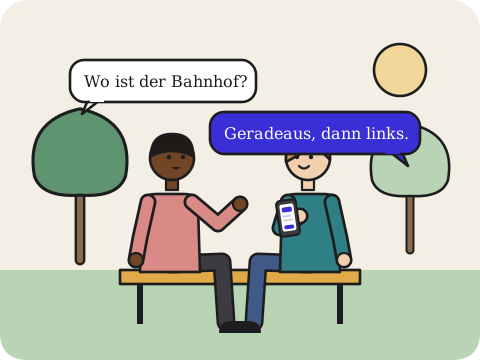
- 37 How do I get to the station?Wie komme ich zum Bahnhof?
- 38 By bus and trainMit Bus und Bahn
- 39 Come along!Komm doch mit!
- 40 Where from? Where to?Woher kommst du? Wohin gehst du?
- 40a Reading and writing: the way to my placeLesen und Schreiben: Der Weg zu mir
- 40b Listening and speaking: out and about in townHören und Sprechen: Unterwegs in der Stadt
- 40c Review: in townWiederholung: In der Stadt
- Test dell’unitàTest Einheit 8 – In der Stadt
ask/give directions, tickets · imperative (du/ihr/Sie), prepositions with dative mit, zu, bei, von, aus, in/an/auf + dative (location)
Unità 9
- Körper und GesundheitBody, doctor, feelings
- 41 My bodyMein Körper
- 42 I'm illIch bin krank
- 43 Making a doctor's appointmentEinen Termin beim Arzt machen
- 44 What does the doctor say?Was sagt die Ärztin?
- 45 How are you? – FeelingsWie geht es dir? – Gefühle
- 45a Reading and writing: I'm ill – a messageLesen und Schreiben: Ich bin krank – eine Nachricht
- 45b Listening and speaking: at the doctor's and on the phoneHören und Sprechen: Beim Arzt und am Telefon
- 45c Review: body and healthWiederholung: Körper und Gesundheit
- Test dell’unitàTest Einheit 9 – Körper und Gesundheit
describe symptoms, make a doctor's appointment, give advice · sollen, dürfen, weh tun, possessive in dative basic
Unità 10
- Rückblick: Was hast du gemacht?Weekend, travel, life story
- 46 What did you do at the weekend?Was hast du am Wochenende gemacht?
- 47 Yesterday I ate a lotGestern habe ich viel gegessen
- 48 I went to ViennaIch bin nach Wien gefahren
- 49 My life – was, had, startedMein Leben – war, hatte, angefangen
- 50 Greetings from Berlin! – Postcard and e-mailViele Grüße aus Berlin! – Postkarte und E-Mail
- 50a Reading and writing: my weekend in SalzburgLesen und Schreiben: Mein Wochenende in Salzburg
- 50b Listening and speaking: what did you experience?Hören und Sprechen: Was hast du erlebt?
- 50c Big review: the whole A1 courseGroße Wiederholung: Der ganze A1-Kurs
- Test dell’unitàTest Einheit 10 – Rückblick: Was hast du gemacht?
talk about the past, write a postcard/e-mail · Perfekt with haben/sein, participles (regular/irregular/separable), war/hatte
Test finale
Un attestato di frequenza della Goethe Academy. Non è un esame di lingua ufficiale.
Vocabulary deck (Anki/CSV)
- German A1 – all units1131 words · Incluso nel corso completo
- Unità 1 · Hallo!92 words · GratisCSV
- Unità 2 · Zahlen und Länder128 words · Incluso nel corso completo
- Unità 3 · Familie115 words · Incluso nel corso completo
- Unità 4 · Essen und Trinken114 words · Incluso nel corso completo
- Unità 5 · Uhrzeit und Alltag91 words · Incluso nel corso completo
- Unità 6 · Freizeit und Termine113 words · Incluso nel corso completo
- Unità 7 · Einkaufen und Wohnen109 words · Incluso nel corso completo
- Unità 8 · In der Stadt88 words · Incluso nel corso completo
- Unità 9 · Körper und Gesundheit97 words · Incluso nel corso completo
- Unità 10 · Rückblick: Was hast du gemacht?78 words · Incluso nel corso completo
CSV in UTF-8 with front, back, example and tags. In Anki: File › Import, the columns are recognised automatically. Unit 1 is free; all other decks are part of the full course.
German reference
Domande
È un esame ufficiale?
No. I nostri corsi seguono le descrizioni pubbliche dei livelli del CEFR. Alla fine ricevete un attestato di frequenza della Goethe Academy, non un esame di lingua ufficiale.
Posso provare prima un corso?
Sì. La prima lezione di ogni corso è gratuita e non richiede un account.
Per quanto tempo ho accesso?
Dodici mesi dall’acquisto, su qualsiasi dispositivo. Non c’è alcun abbonamento.
Quanto costano i corsi?
Tedesco A1, A2, B1, B2 e C1 costano ciascuno AED 249 (USD 69). I corsi di scrittura costano da AED 199 a 349 (da USD 55 a 95). Ogni prezzo è un pagamento unico per 12 mesi di accesso.
Chi gestisce la Goethe Academy?
La Goethe Academy è gestita da ICSL FZE, Sharjah, la società che sta dietro a Goethe Write e alla biblioteca Goethe su goethecloud.com. Non è collegata ad alcun ente d’esame ufficiale.
Come posso imparare il tedesco online?
Iniziate con Tedesco A1: 50 brevi lezioni con dialoghi audio, vocabolario, grammatica ed esercizi che si correggono da soli. La lezione 1 è gratuita e non richiede un account. Poi proseguite livello dopo livello fino a C1.
Esiste un corso di tedesco per arabofoni?
Sì. Ogni lezione di Tedesco A1 ha spiegazioni in arabo oltre che in inglese. Da A2 in poi le spiegazioni sono in inglese.
Esiste un corso di tedesco per infermieri?
I nostri corsi insegnano tedesco generale con temi di lavoro da A2 in poi, come colleghi, colloqui di lavoro, sistema sanitario e medicina. Non sono corsi specialistici di infermieristica.
Posso seguire un corso di tedesco B1 online?
Sì. Tedesco B1 ha 50 lezioni in 10 unità su lavoro, relazioni, salute, media, viaggi e società, con un test dopo ogni unità. Il livello CEFR B1 è quello richiesto da molte procedure di soggiorno e di naturalizzazione; il nostro attestato di frequenza non è un esame ufficiale.